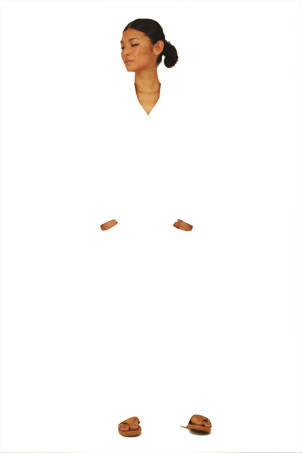
hadaka no oosama
when can one stop painting? in certain asiatic painting traditions
the people who are considered to be master artists (and who can,
as such perhaps stop painting) are those who are able to
reproduce a traditional sign most consummately, and with
enormous concentration. out of this reduction, and out of this
struggle with traditions, they draw the strength to create new
forms.
when can one stop producing clothes? here, too, the answer
might be: if one has created "perfect clothes" through reduction,
concentration, and a confrontation with tradition.
with her
collection, edwina hoerl presents clothes
whose form and colourfulness is so restrained that they leave
their wearers almost naked. one wraps oneself in white, light-grey
or skin-coloured textiles, which are laid around the body in simple
patterns, and and as it were with seemingly invisible seams.
clothes tahat look like milk-white memories of clothes; clothes that
are long, stretched t-shirts and t-shirts that slip over the hips and
onto the back. wide jackets that enclose the head and the body
like a spacious tent, and soft overalls that give space to the body-
centre. around the neck hang thick loops in orange-beige and an
enormous bag for essential things and for one's travels. clothes
that one has always already experienced, but never like this,
never in this way. like the emperor in the fairy tale the emperor's
new clothes, one can move in them without the person opposite
being certain: is this person dressed? do i see clothes? or do i
see something coming towards me that comes from my memory
of clothes? is seeing an issue? does it feel like clothes? what am i
experiencing? clothes or nakedness? what clothes?
anna schober
» read more in english
» read more in german
» download poster
photography / seiji shibuya
model / hikaru
make-up / lyar (piccadilly)
art direction and graphic design / so+ba
print / hashimoto printing co.,ltd.
- しあわせ ZUM GLÜCK
- 四 shi
- please — consider me a dream
- abrakadabra
- peace please! on the move
- down to earth
- i am an animal
- older
- tan tan tan run run run
- family gang
- song for the colleagues
- sex
- pen-pen-gusa
- schön schweigen
- now! holiday for everyone
- aaa
- never give up
- namida 涙
- fkk
- schonen
- ~poi
- kiki
- mimi
- untitled
- piratery-garderobbery
- kuroneko
- evergreen
- hadaka no oosama
- ringelspiel
- yoyogi yoga
裸の王様
人はいつ描くということをやめることができるのか。アジアの絵画の 伝統の中には代々伝えられてきた形を完璧にまた極度の集中力をもっ て再現できる画家が名人である(または名人として描くことを止める ことができる)と見なされるものがある。彼等はこのように余分なも のを捨てて、また伝統と格闘することによって新しい形式を創造する 力を獲得する。 人はいつ服を創作することを止めることができるのか。この問いには こんな風に答えることができよう:余分なものを削ぎ取ることで、集 中することで、伝統との格闘によって「完成された」服を作った時に、 と。エドウィナ ホールの「裸の王様」コレクションの作品では形も 色も後退して服を着ている人はまるで裸でいるように見える。白、薄 いグレー、肌色の布が単純なカットで、まるで「見えない」糸で縫っ たようにして体にまとわりつく。長く引き延ばしたシャツ、腰の回り や背中にずり落ちてくるシャツが服である。頭や身体を大きなテント にように包み込む白いジャケット、身体のまん中にたっぷり余裕をの こしたオーバーオール。首に巻かれた肌色の縄と生きるのに必要なも のだけを詰め込んだ、また放浪の旅のための大きな大きな袋。人がい つも着ている服なのにこんな風には着たことがない。童話の「王様の あたらしい服」の王のようにその服を着る人は楽に動いているのに、 見る者たちは自信がない:この人は服を着ているのだろうか?私が見 ているのは服?それとも服を見たことがあるからそうだと思っている 物だろうか?見方の問題?触ってみれば服なのか?これは一体なんだ ろう。服それとも裸?服ならどんな服なのだろう?
anna schober
» read more in english
» read more in german
» download poster
photography / seiji shibuya
model / hikaru
make-up / lyar (piccadilly)
art direction and graphic design / so+ba
print / hashimoto printing co.,ltd.
人はいつ描くということをやめることができるのか。アジアの絵画の 伝統の中には代々伝えられてきた形を完璧にまた極度の集中力をもっ て再現できる画家が名人である(または名人として描くことを止める ことができる)と見なされるものがある。彼等はこのように余分なも のを捨てて、また伝統と格闘することによって新しい形式を創造する 力を獲得する。 人はいつ服を創作することを止めることができるのか。この問いには こんな風に答えることができよう:余分なものを削ぎ取ることで、集 中することで、伝統との格闘によって「完成された」服を作った時に、 と。エドウィナ ホールの「裸の王様」コレクションの作品では形も 色も後退して服を着ている人はまるで裸でいるように見える。白、薄 いグレー、肌色の布が単純なカットで、まるで「見えない」糸で縫っ たようにして体にまとわりつく。長く引き延ばしたシャツ、腰の回り や背中にずり落ちてくるシャツが服である。頭や身体を大きなテント にように包み込む白いジャケット、身体のまん中にたっぷり余裕をの こしたオーバーオール。首に巻かれた肌色の縄と生きるのに必要なも のだけを詰め込んだ、また放浪の旅のための大きな大きな袋。人がい つも着ている服なのにこんな風には着たことがない。童話の「王様の あたらしい服」の王のようにその服を着る人は楽に動いているのに、 見る者たちは自信がない:この人は服を着ているのだろうか?私が見 ているのは服?それとも服を見たことがあるからそうだと思っている 物だろうか?見方の問題?触ってみれば服なのか?これは一体なんだ ろう。服それとも裸?服ならどんな服なのだろう?
anna schober
» read more in english
» read more in german
» download poster
photography / seiji shibuya
model / hikaru
make-up / lyar (piccadilly)
art direction and graphic design / so+ba
print / hashimoto printing co.,ltd.